
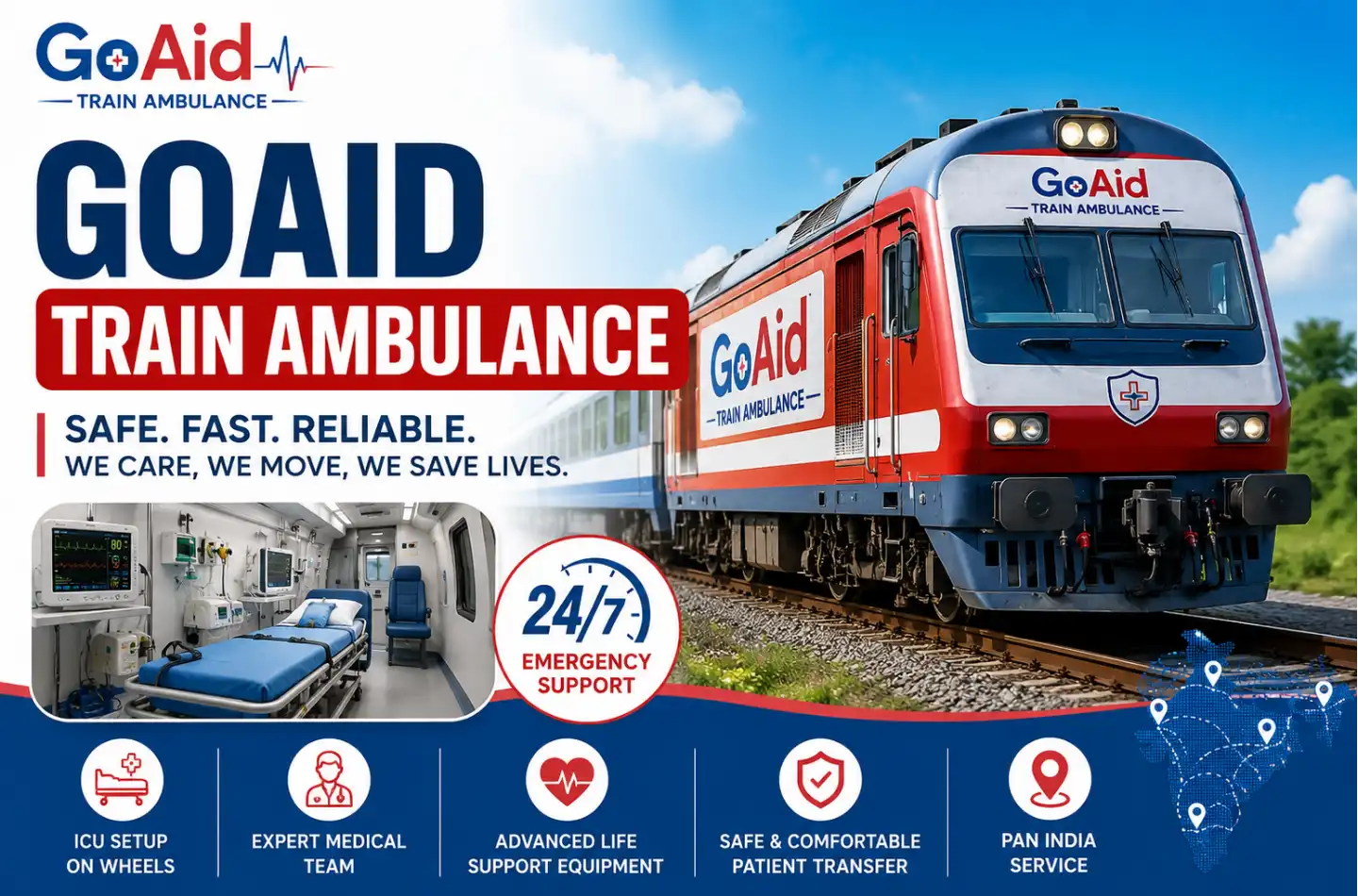
For long-distance transits for a medical purpose, it is always best to choose a train-ambulance service. It saves almost around 8-10% of costs compared to air ambulances and is more feasible from the road ambulance service. Train ambulances in India are covered in more than 450 cities by Indian Railways and offer a smooth, secure journey for critical and every patient.
What is a train ambulance? How it works in India.
A train ambulance is an ambulance on rails, where a train compartment is converted into a full-fledged ICU on wheels for safely transferring patients from one place to another. The service is usually used for intercity, interstate emergency medical transports.
Having all the equipment in the train is so much better than a normal train coach for a patient, where you are assisted by a professional medical team and monitored through ICU-level devices. Offering you a service full of security, reliability, and affordability.
How a train ambulance is converted into a mobile ICU
A normal train coach is converted into a mobile ICU train setup with loads of equipment. The medical team installs various advanced life support devices in the compartment before the transit begins. Devices like oxygen cylinder ambulance train support, cardiac monitoring during transfer, ECG machine train ambulance setup, ventilator train ambulance India support, suction apparatus, and many more are set up. This medical transport by train India makes sure that the patients receive uninterrupted care during the journey.
Bed-to-bed transfer
A service called bed-to-bed transfer is offered by train ambulance service providers in India, where the road ambulance team picks you up from the location provided to the onboarding railway station, and then the ICU train ambulance team boards the patient carefully. Later on, after reaching the destined station, our road ambulance team again picks you up and drops you off at your receiving hospital with safety. This all inclusive train ambulance process helps patients and family to reduce stress and get continuous medical care.
What medical equipment is inside a train ambulance?
The modern ICU train ambulance service in India is equipped as a hospital ICU. Patients' health determines what equipment needs to be installed in the train coach and what type of ICU is to be configured.
- Basic setup: Patients with stable heartbeats, elderly patients, post-surgery patients, and others are advised to go for basic ICU setup in a train ambulance. In this type, devices like oxygen cylinders, stretchers, IV drips, oximeters, and BP monitoring devices are available.
- Semi-ICU setup: This arrangement is suitable for cardiac, neurological, and moderate-risk medical cases. An ECG machine, cardiac monitor, defibrillator, syringe pumps, emergency medication support, and a trained EMT staff are present there for you.
- Full ICU setup: Patients on ventilators or in a critical state that needs continuous monitoring need this setup for their long journey. All ICU-grade devices are present, like ventilators, advanced cardiac monitoring, emergency crash carts, and continuous ICU monitoring.
Top 7 reasons train ambulance is best for long distance
There are many reasons for you to choose Train Ambulance, but the best 7 are listed below:
- Cost: 8-10x cheaper than air ambulance - The biggest reason for you to choose is the cost; for a long distance, it will also be much. Air ambulance costs in India can go from ₹3 lakh to ₹10 lakh depending on distance and medical setup. In comparison, train ambulance costs in India are significantly lower while still providing ICU support.
- Stability: no turbulence, steady ride for critical patients - Unlike the other modes of ambulances, this travel is smoother and more stable without any turbulence. This is the best with fewer hemodynamic fluctuations during train travel, making it safe.
- Space: full AC compartment for patient and family - The train compartments are way more spacious than road and air ambulances. Patients get more space to move, comfortable positioning, and a better hygiene environment.
- Coverage: 450+ cities via Indian Railways - This service is available across India’s major railway networks. All cities like Delhi, Pune, Jaipur, Hyderabad, and more. This wide network makes rail ambulance service in India one of the most accessible emergency transport systems.
- Continuous care: doctor & paramedic on board - Another reason to choose a train ambulance is the continuous monitoring offered by the train ambulance medical team.
- Family travel: attendants can accompany the patient - Most of the train ambulances allow family members to travel with the patient. This helps the emotional stress, anxiety, and discomfort of patients when their family is with them.
- No hemodynamic fluctuations - Patients in critical condition are often prone to physiological instability during flights due to changes in altitude and pressure. Train ambulance services to prevent such complications. This makes train ambulances much safer in many situations for stable versus critical patient transport.
Train ambulance vs air ambulance vs road ambulance
Choosing the best out of the three modes of ambulance transport, depends on what you wish for.
Speed Comparison
Train Ambulance
- Highest comfort-to-cost ratio
- Suitable for stable to moderately critical patients
Air Ambulance
- Quickest way to get around
- Best for dire emergencies
- Extremely, extremely expensive
Road Ambulance
- Slower in crossing borders
- Traffic delay risk (TDR)
- Less comfortable on long distances
When to Choose Which Option
Choose Train Ambulance When:
- The patient is stable or semi-critical.
- You will have to travel long distances
- Constrained budget
- Continuous monitoring is needed
- Patient is to be accompanied by family
Choose Air Ambulance When:
- The patient needs urgent emergency transfer
- Time is very critical
- The patient is hemodynamically unstable
Choose Road Ambulance When:
- Need short-distance transfer
- Need transfer to local hospital
- Need transportation nearby immediately
Who should use a train ambulance?
Train ambulances are suitable for almost every patient; specific ones could be:
- Post-surgery patients: Patients who have gone through surgery and are now going back to their place should definitely choose a train ambulance, as it monitors the pulses regularly, the medical team keeps a check on them, and it ensures a smooth transit.
- Cancer patient on long-distance transfer: It is the safest option for cancer patients with the support of oxygen, pain management, long-duration monitoring, and comfortable travel.
- Cardiac & neurological patients: Any patient suffering from stroke, cardiac issues, paralysis, or any related health issues should go with this service for its continuous monitoring and certified medical crew ready for any kind of emergency symptoms shown.
- Elderly Patients: Train ambulances are always better and safer for aged patients, as they offer comfortable long journeys, fewer vibrations and turbulence, familiarity with the process, and the company of family members
- Neonatal & Pediatric Transfers: There's a specialized train ambulance team for neonatal & pediatric transfers. These cases require pediatric monitoring, oxygen support, and special medical teams for our little patient travelers.
Train ambulance cost in India: complete breakdown
The cost of train ambulance in India depends on a number of factors like distance, patient condition, medical setup and staff needs.
Basic Setup – ₹30,000 to ₹60,000
Basic train ambulance packages usually include the following:
- Oxygen support
- Stretcher arrangement
- Basic medical supervision
- EMT support
- Bed-to-bed transfer assistance
Suitable for stable patients.
Semi-ICU Package – ₹60,000 to ₹90,000
Semi-ICU train ambulance India packages may include the following:
- Cardiac monitor
- ECG machine
- Oxygen support
- Emergency medicines
- EMT and medical assistance
Suitable for moderate-risk patients.
Full ICU Package – ₹90,000 to ₹1,10,000
Full ICU train ambulance India setup may include the following:
- Ventilator support
- ICU monitoring
- MBBS doctor on train
- Paramedic support
- Advanced life-saving equipment
Suitable for critical patient transport by train.
What Factors Affect the Cost?
Several factors affect train ambulance costs in India:
- Distance between cities
- Patient condition
- ICU setup type
- Number of medical staff
- Ventilator requirement
- Emergency medicines
- Railway ticket category
- Road ambulance support
Does Insurance Cover Train Ambulances?
Yes, in some cases. Some health insurance policies may pay a portion of the costs:
- Emergency medical transport
- Transfer to ICU Charges
- Hospital-to-hospital transfer costs
Patients should verify coverage with their insurance company.
How to book a train ambulance in India: step-by-step
Perform these 5 steps to get a train ambulance booked for you.
Step 1: Call provider with patient details
The very first thing to do is to call on the 24x7 helpline number of the train ambulance service provider. Share details of the patient like name, address, health condition, treating physician, receiving hospital, date and time, and need of medical staff.
Step 2: Medical assessment for train fitness
After checking on the details shared, the medical team evaluates whether the patient can travel or not and, if yes, then what kind of ICU configuration is required, equipment is needed, and if a medical staff is needed or not.
Step 3: Train ticket + ICU setup arrangement
Once everything is checked, then the provider confirms the tickets of the patient and family members, ICU train setup, equipment installation, and the composition of staff.
Step 4: Road ambulance pickup from home/hospital
The train ambulance includes bed-to-bed transfer service, where they pick you up from the location and take you to the departure railway.
Step 5: Board train → travel → destination handover
The next step is helping you board the train, assisting you in the travel, and then dropping you off at the receiving hospital. Ensuring total comfort for the patient from start to end.
Major routes covered: PAN-INDIA
In India, train ambulance services now offer medical transfers across the country, using the Indian Railways network. Train ambulance providers have access to over 450 cities and towns ensuring safe, affordable and medically supervised intercity patient transfer over long distances.
Some of the major train ambulance routes across India include:
- Train ambulance Delhi to Patna
- Train ambulance Delhi to Mumbai
- Train ambulance Delhi to Kolkata
- Train ambulance Mumbai to Patna
- Train ambulance Kolkata to Delhi
- Train ambulance Hyderabad to Delhi
- Train ambulance Chennai to Patna
- Train ambulance Bangalore to Delhi
- Train ambulance Ranchi to Delhi
- Train ambulance Guwahati to Kolkata
These routes connect patients to the best hospitals in metro cities like Delhi, Mumbai, Chennai, Jaipur, Hyderabad, Bangalore and Kolkata, gurugram and have state-of-the-art medical treatment facilities.
FAQ: Train AMbulance Service in India
1. What is a train ambulance service?
A train ambulance service is a medical transportation system where a train compartment is converted into a mobile ICU for safe long-distance patient transfer. It includes medical equipment, oxygen support, ICU monitoring, and trained medical staff.
2. Is train ambulance safe for critically ill patients?
Yes, train ambulance services are considered safe for many critically ill patients when proper medical monitoring and ICU support are provided during travel. The smooth train journey also reduces physical stress.
3. What is the cost of train ambulance in India?
Train ambulance cost in India generally ranges from ₹30,000 to ₹1,10,000 depending on distance, patient condition, ICU setup, and medical equipment requirements.
4. How long does a train ambulance journey take?
The duration depends on the travel route and train availability. Most long-distance train ambulance journeys in India take between 8 hours and 48 hours.
5. Train ambulance vs air ambulance , which is better?
Train ambulance is better for affordable long-distance medical transfer with stable ICU support, while air ambulance is preferred for extremely urgent emergency transfers.
6. Does health insurance cover train ambulance?
Some health insurance providers may reimburse train ambulance expenses under emergency transport or hospitalization coverage. Patients should confirm policy details before booking.
7. Can family members travel with the patient?
Yes, most train ambulance services allow attendants or family members to travel with the patient in the same compartment.
8. What equipment is available in a train ambulance?
Train ambulances may include oxygen cylinders, ECG monitors, ventilators, suction machines, cardiac monitors, IV drips, infusion pumps, and emergency medicines.
9. How do I book a train ambulance?
You can book a train ambulance by contacting a 24/7 train ambulance service provider and sharing the patient’s medical details, transfer route, and support requirements.
10. Which cities have train ambulance service?
Train ambulance services are available across major Indian cities including Delhi, Mumbai, Kolkata, Patna, Hyderabad, Chennai, Bangalore, Ranchi, Noida, Guwahati, and many more.